Key Takeaways
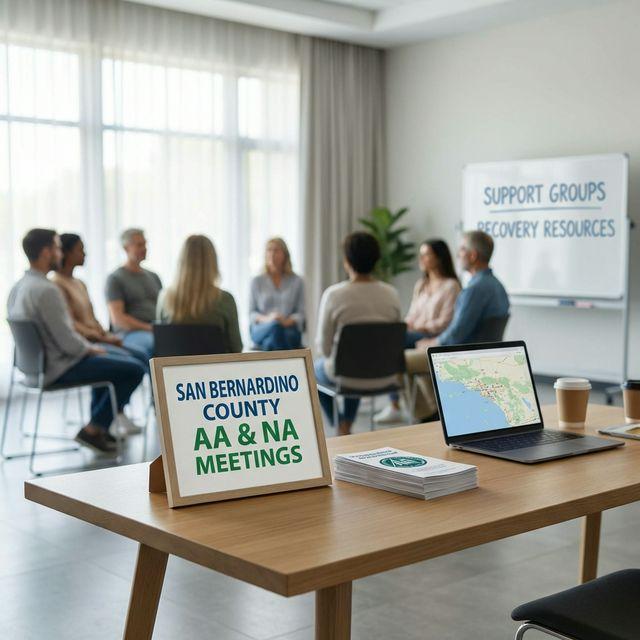
- San Bernardino County hosts hundreds of AA and NA meetings weekly across the Inland Empire.
- Meetings are available in multiple formats including open, closed, speaker, and step study.
- Spanish-language and bilingual meetings are widely available throughout the county.
- 12-step programs are most effective when combined with professional addiction treatment.
- Online meeting directories and apps make finding local meetings easy and immediate.
The Role of 12-Step Meetings in Recovery
Alcoholics Anonymous and Narcotics Anonymous have been foundational components of addiction recovery for decades. These peer-led support groups provide a structured framework for maintaining sobriety through shared experience, mutual accountability, and the 12-step program of personal growth and spiritual development.
Research supports the effectiveness of 12-step participation, particularly when combined with professional treatment. A landmark study published in the Cochrane Database of Systematic Reviews found that AA participation was as effective as other established treatments in achieving abstinence and was associated with significant healthcare cost savings.
San Bernardino County's recovery community maintains a robust network of meetings that serve individuals at every stage of recovery, from those attending their first meeting to longtime members with years of sobriety. This diversity creates an environment where newcomers can find hope and long-timers can continue to grow.
Finding AA Meetings in San Bernardino County
Alcoholics Anonymous meetings in San Bernardino County are coordinated through the Inland Empire Central Office, which maintains an up-to-date directory of all registered meetings across the region. Meetings are held daily at churches, community centers, hospitals, and dedicated meeting halls throughout the county.
The western corridor, including cities like Ontario, Rancho Cucamonga, Upland, and Fontana, offers the highest concentration of meetings due to population density. The city of San Bernardino and neighboring communities like Redlands and Loma Linda also host numerous weekly meetings.
High Desert communities including Victorville, Hesperia, and Apple Valley have a growing number of AA meetings, though options are more limited than in the valley. Online meetings supplement in-person options for residents in more remote areas of the county.
- Open meetings welcome anyone interested in learning about AA, including family members
- Closed meetings are for individuals who identify as alcoholics or who have a desire to stop drinking
- Speaker meetings feature one or two individuals sharing their recovery stories
- Step study and Big Book study meetings focus on working through the 12 steps
- Spanish-language and bilingual meetings available in many communities
Finding NA Meetings in San Bernardino County
Narcotics Anonymous meetings serve individuals recovering from addiction to any substance, not just narcotics. The Inland Empire NA community is active and growing, with meetings held throughout San Bernardino County in formats similar to AA.
NA meetings are particularly prevalent in the western Inland Empire and in the city of San Bernardino, where the drug crisis has driven strong community-based recovery responses. Like AA, NA offers open and closed meetings, speaker formats, and step study groups.
The NA regional service committee maintains a meeting directory and helpline to connect newcomers with meetings and sponsors. Many NA groups also participate in community outreach, carrying the message of recovery to jails, treatment centers, and community events.
What to Expect at Your First Meeting
Attending your first AA or NA meeting can feel intimidating, but understanding what to expect can ease the anxiety. Most meetings begin with a welcome and reading of the group's preamble, followed by a moment of silence or the Serenity Prayer. The format then varies depending on the meeting type, with some featuring a single speaker and others opening the floor for sharing.
You are not required to speak at your first meeting. Many newcomers choose to simply listen and observe. If you do share, keeping your comments brief and focused on your own experience is customary. Confidentiality is a core principle: what is shared in meetings stays in meetings.
After the meeting, members often gather informally for coffee or conversation. This is an excellent opportunity to introduce yourself, exchange phone numbers, and begin building the support network that will sustain your recovery.
Try at least six different meetings before deciding whether 12-step programs are right for you. Each meeting has its own personality and culture, and the group that feels like home may be the third or fourth one you try.
Alternative Recovery Support Groups
While AA and NA are the most widely available recovery support groups in San Bernardino County, they are not the only options. SMART Recovery uses a cognitive-behavioral, self-empowerment approach that appeals to individuals who prefer a secular, science-based framework.
Celebrate Recovery, hosted at churches throughout the Inland Empire, offers a faith-based approach to recovery from a wide range of addictive and compulsive behaviors. Refuge Recovery and Recovery Dharma provide mindfulness-based alternatives rooted in Buddhist philosophy.
The key is finding a recovery community that resonates with your values and supports your long-term goals. Many individuals participate in multiple types of recovery support groups simultaneously, drawing different benefits from each.
Integrating Meetings with Professional Treatment
Recovery support meetings are most effective when they complement professional addiction treatment rather than replace it. Evidence-based treatment programs like those offered at Trust SoCal in Fountain Valley incorporate 12-step facilitation as part of a comprehensive clinical approach that also includes individual therapy, group counseling, and medication management.
During and after residential or outpatient treatment, regular meeting attendance provides ongoing peer support, accountability, and connection to a sober community. Many treatment programs encourage clients to begin attending local meetings during treatment and to establish a meeting schedule as part of their aftercare plan.
Trust SoCal helps clients connect with recovery meeting communities in both Orange County and their home communities. For San Bernardino County residents, this means building relationships in the Inland Empire recovery community before completing treatment, ensuring a seamless transition and continuous support.
Amy Pride, MFTT
Marriage & Family Therapy Trainee