Key Takeaways
- Court-ordered rehab is mandated by a judge as an alternative to incarceration
- Ventura County Drug Court offers structured treatment as an alternative to prison for eligible offenders
- Compliance requires completing specific treatment requirements and providing documentation to the court
- Court-mandated clients achieve comparable recovery outcomes to voluntary clients
- Trust SoCal accepts court-ordered clients and provides required compliance documentation
Understanding Court-Ordered Rehab in Ventura County
Court-ordered rehabilitation, also known as mandatory or mandated treatment, occurs when a judge requires an individual to complete addiction treatment as part of a criminal sentence, probation conditions, or diversion program. In Ventura County, court-ordered rehab is commonly associated with DUI offenses, drug possession charges, and other substance-related criminal matters.
While entering treatment by court mandate rather than personal choice may feel different initially, research from the National Institute on Drug Abuse shows that individuals who enter treatment under legal pressure have outcomes comparable to those who enter voluntarily. The key factor in success is not how someone enters treatment, but whether the program is evidence-based and comprehensive.
Ventura County courts recognize that addiction is a treatable medical condition and that treatment produces better outcomes than incarceration alone. Programs like the Ventura County Drug Court provide structured pathways that combine judicial oversight with clinical treatment, creating accountability frameworks that support recovery.
Ventura County Drug Court
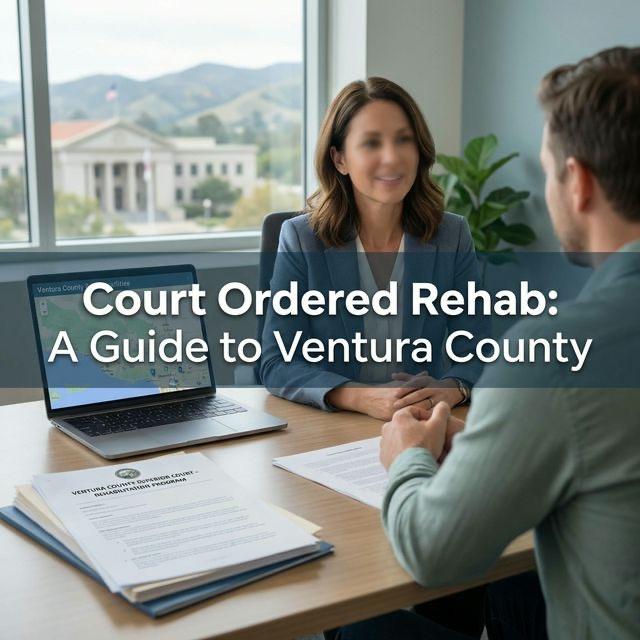
The Ventura County Superior Court operates a Drug Court program that serves as an alternative to traditional criminal prosecution for eligible defendants with substance use disorders. Drug Court combines judicial supervision, mandatory drug testing, graduated sanctions and incentives, and comprehensive treatment to address the root causes of drug-related criminal behavior.
Participants in Drug Court are required to attend regular court hearings, complete assigned treatment programs, submit to random drug testing, maintain employment or educational enrollment, and meet other program-specific requirements. Successful completion of Drug Court can result in reduced charges, dismissed cases, or expunged records depending on the specific program track.
- Judicial supervision with regular court appearances before the Drug Court judge
- Mandatory substance abuse treatment including individual and group therapy
- Random drug and alcohol testing, typically 2 to 3 times per week
- Graduated phases with increasing privileges and decreasing supervision
- Community service requirements in most program tracks
- Peer support group attendance (AA, NA, or equivalent)
- Case management and wraparound services including employment assistance
Types of Court-Ordered Treatment
Depending on the nature of the offense, the severity of the substance use disorder, and the specific court requirements, different levels of treatment may be mandated.
DUI Programs
California law requires individuals convicted of DUI to complete specific alcohol education and treatment programs. First-offense DUI typically requires a 3-month program, while multiple DUI convictions may require 18-month or 30-month programs. These programs include education, group counseling, and individual sessions.
Prop 36 (SACPA) Treatment
Proposition 36, the Substance Abuse and Crime Prevention Act, allows eligible nonviolent drug offenders to receive treatment instead of incarceration. Participants must complete a certified treatment program and comply with court-ordered conditions to have charges reduced or dismissed.
Residential Treatment
In cases involving severe substance use disorders or when outpatient programs have failed, courts may order residential treatment at a licensed facility. Trust SoCal accepts court-ordered residential clients and provides all required documentation and progress reports to the court.
Compliance Requirements and Documentation
Meeting court-ordered treatment requirements demands careful attention to compliance documentation. Treatment facilities are typically required to provide regular progress reports to the court, probation officer, or attorney. These reports document attendance, participation, drug test results, and clinical progress.
Trust SoCal understands the importance of thorough compliance documentation and provides comprehensive reporting to courts and probation departments. Our admissions team works directly with clients' legal representatives to ensure that treatment plans meet all court-specified requirements.
If you have been ordered to attend rehab, bring all court documents to your intake appointment. Trust SoCal's team will review the specific requirements and ensure your treatment plan satisfies every mandate.
Making the Most of Mandated Treatment
Regardless of how you arrive at treatment, the opportunity for genuine recovery is real. Many individuals who initially enter treatment under court order discover that the process transforms their lives in ways they never anticipated. The structure and accountability provided by the legal system can actually support recovery by removing the option to quit prematurely.
Trust SoCal treats every client with the same compassion, clinical rigor, and individualized attention, regardless of whether they entered treatment voluntarily or by court order. If you need to fulfill a court-ordered treatment requirement in Ventura County, call (949) 280-8360 to discuss how our programs can help you meet your legal obligations while building a foundation for lasting recovery.
Madeline Villarreal, Counselor
Counselor