Key Takeaways
- Green Bay, Appleton, and other Northeast Wisconsin cities have community-based treatment programs, but specialized services are often limited compared to Madison and Milwaukee.
- Rural communities in Brown County (Green Bay) and Outagamie County (Appleton) face particular barriers to medication-assisted treatment access and residential treatment capacity.
- Community health centers, primary care physicians, and hospital-based programs in Green Bay and Appleton provide foundational addiction services.
- Traveling to Madison or Milwaukee for residential or specialized treatment is common for residents of Green Bay, Appleton, and surrounding communities.
- Recovery support networks in small cities require more intentional community building but often benefit from strong social institutions including churches and civic organizations.
- Some Northeast Wisconsin residents find that out-of-state treatment in Southern California offers advantages including specialized programming and complete environmental change.
Addiction Challenges in Northeast Wisconsin Small Cities
Green Bay, Appleton, Oshkosh, and the smaller communities of Northeast Wisconsin face substance use disorders rooted in the same forces affecting larger Wisconsin cities, but compounded by limited treatment infrastructure and the particular isolation of small-town life. The Green Bay Packers culture, rooted in decades of community identity and football tradition, has created strong social cohesion, but also normalizes alcohol use in ways that can mask alcohol use disorders and alcohol-related family disruption. Appleton, home to Lawrence University and the Paper Valley Hotel, has the cultural amenities of a small college town, but has seen rising opioid and methamphetamine use particularly among young adults.
Brown County (Green Bay) and Outagamie County (Appleton) report opioid-related overdose deaths and fentanyl contamination of drug supplies consistent with statewide trends. Methamphetamine use is particularly prevalent in rural areas surrounding Green Bay and Appleton, where drug trafficking routes from major cartels deliver product through rural communities. For individuals with substance use disorders in these communities, the shame associated with addiction in small towns where "everyone knows everyone" can be a major barrier to help-seeking. Additionally, the reality that recovery meetings, treatment centers, and recovery-oriented employment opportunities are limited means that maintaining anonymity while in recovery is challenging.
Young adults in Green Bay and Appleton face particular vulnerability to substance use. The transition from high school to adulthood, compounded by limited job prospects for those without college degrees and the allure of opioids or methamphetamine as self-medication for depression and anxiety, creates a pipeline into addiction. Women in these communities face additional barriers including stigma surrounding female addiction and limited access to gender-responsive treatment. Gender-specific programming for women, pregnant women, and mothers is sparse in these smaller communities.
Residents of Green Bay, Appleton, and Northeast Wisconsin small cities can access the Wisconsin SAMHIC at 1-800-892-2925 for referrals to treatment programs in their area or in larger Wisconsin cities like Madison and Milwaukee. The helpline connects callers with current information on available beds and can expedite intake appointments.
Local Treatment Options in Northeast Wisconsin
Community health centers in Green Bay and Appleton provide foundational substance use disorder screening, assessment, and initial treatment services. Aurora Health Care operates facilities in Green Bay where individuals can access primary care, urgent care, and some behavioral health services. Several local primary care practices have begun screening for substance use disorders and offering counseling and buprenorphine initiation for opioid use disorders. The Brown County Department of Health Services provides public health resources including information about treatment options and harm reduction services.
Residential treatment capacity in Green Bay and Appleton is limited. While detoxification can be accessed at local hospitals, individuals seeking longer-term residential treatment often must travel to Madison, Milwaukee, or other larger Wisconsin cities. Intensive outpatient programming is available in some settings but may be limited compared to larger cities. The reality is that residents of Northeast Wisconsin small cities often face difficult choices: access limited local treatment, travel to larger cities for more robust programming, or consider out-of-state options that offer combination of clinical expertise and therapeutic environment change.
Treatment Services Available in Green Bay and Appleton
Several organizations and healthcare providers in Green Bay, Appleton, and Northeast Wisconsin offer addiction treatment services. While specialized options may be more limited than in larger Wisconsin cities, foundational services are accessible.
- Aurora Health Care in Green Bay providing emergency detoxification and primary care-based behavioral health services
- Community health centers in Green Bay and Appleton offering primary care-based substance use disorder screening, counseling, and buprenorphine treatment
- Primary care practices throughout Northeast Wisconsin increasingly screening for substance use disorders and offering brief intervention and treatment initiation
- Wisconsin Department of Health Services resources and referral services available through the Wisconsin SAMHIC at 1-800-892-2925
Barriers to Treatment in Small Communities
The primary barrier to addiction treatment in Green Bay, Appleton, and other Northeast Wisconsin small cities is limited treatment infrastructure combined with geographic isolation. Residents needing residential treatment face choices between staying in their communities with limited options or traveling to larger cities like Madison or Milwaukee where capacity is greater. The shame associated with addiction in small towns where anonymity is impossible can deter help-seeking; individuals worried about being seen entering a treatment center or attending recovery meetings face psychological barriers beyond those in larger cities.
Transportation is another significant barrier. While Green Bay and Appleton have local public transportation, the reliability and convenience cannot match larger cities. Individuals without reliable personal vehicles struggle to access treatment. For rural communities outside the immediate Green Bay or Appleton areas, transportation barriers can be even more severe. The absence of medication-assisted treatment providers, particularly buprenorphine prescribers, in some smaller towns means that individuals seeking MAT must travel significant distances or rely on telephone or video-based prescribing if available.
If you are living in a small Northeast Wisconsin community and seeking treatment, do not let shame or fear of community recognition prevent you from reaching out. The Wisconsin SAMHIC confidential helpline at 1-800-892-2925 can provide information without your identity being known locally. Telehealth services are increasingly available, allowing you to connect with prescribers and counselors remotely.
The Role of Community Organizations and Faith Institutions
In small cities like Green Bay and Appleton, community organizations and faith institutions play a more prominent role in addiction response than in larger cities. Churches, civic groups, and longstanding community institutions often serve as anchors for recovery support networks. The intimacy of small community life, which can make help-seeking difficult, also means that once someone reaches out, the availability of personal connection and accountability through community-based organizations can be powerful supports for recovery.
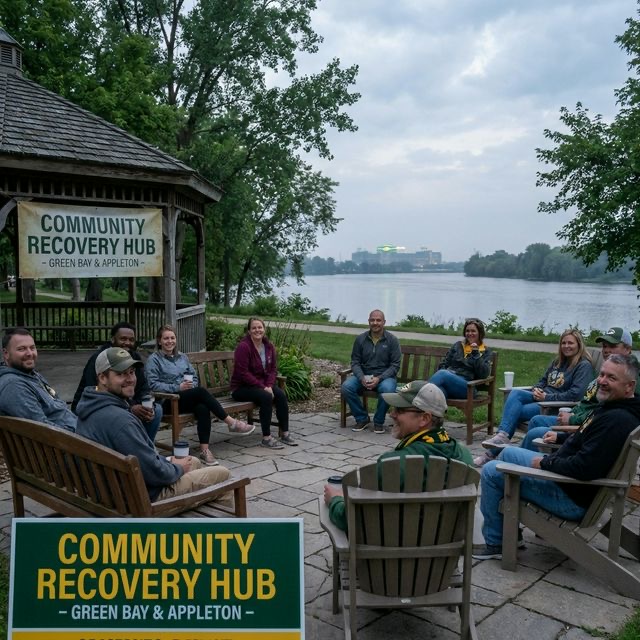
Green Bay Packers fans represent a cultural institution that transcends typical community boundaries. Some Green Bay-based recovery communities have creatively leveraged this shared identity to build peer support networks among individuals in recovery. Recovery meetings held in familiar community spaces like church basements or community centers can feel more accessible than treatment facilities in larger cities. Peer support specialists who are known and trusted in the community can be more effective at engaging individuals in treatment than providers from outside the community.
When Larger City or Out-of-State Treatment Makes Sense
For residents of Green Bay, Appleton, and Northeast Wisconsin small cities, residential treatment in Madison, Milwaukee, or Southern California may be the right choice depending on individual circumstances. Those needing specialized programming—such as trauma-focused treatment, LGBTQ+-specific programming, or programs for young adults or women—may find limited or no options locally and benefit from traveling to larger treatment centers. Additionally, individuals whose recovery is threatened by triggers embedded in their local communities—friends, familiar locations, family dynamics—may benefit from geographic distance provided by treating in Madison, Milwaukee, or California.
Trust SoCal in Fountain Valley, California offers specialized programming that may not be available in Northeast Wisconsin. The program provides individualized treatment, holistic wellness integration, and the therapeutic impact of complete environmental change. For Green Bay and Appleton residents considering out-of-state treatment, the admissions team at (949) 280-8360 can discuss whether this option aligns with treatment goals and can verify insurance coverage.
Growing up in a small Northeast Wisconsin city, I knew everyone and everyone knew my business. When I needed treatment, leaving for Southern California wasn't just about finding better clinical services—it was about getting the space to become a different person, to not be defined by my past in a community where everyone remembered it.
— Resident of Appleton who completed treatment in California
Building Sustainable Recovery in Small Communities
Whether completing treatment locally, in Madison or Milwaukee, or in Southern California, individuals from Green Bay and Appleton returning to their home communities face the task of building sustainable recovery networks in environments with limited formal resources. The strengths of small communities—social cohesion, value placed on personal relationships, established community institutions—can become assets for recovery if intentionally leveraged. Finding a church community, joining civic organizations, building accountability relationships with family and friends, and participating in recovery meetings (whether in person or online) create the scaffolding for long-term sobriety.
Online recovery communities, smartphone-based peer support apps, and video-based counseling services can supplement limited local resources. Individuals in small communities should not hesitate to build recovery networks that extend beyond their geographic locality. Long-distance sponsorship relationships, online support groups, and periodic in-person retreats can provide the connection and accountability that might not be available locally. The key is being intentional and proactive about recovery community building in environments where resources are scarce.

Trust SoCal Editorial Team, Clinical Review Board
Editorial & Clinical Review