Key Takeaways
- Adventure sports provide intense, natural dopamine and adrenaline release that satisfies the sensation-seeking tendency common in people with addiction histories.
- The focused attention required by challenging physical activities creates a flow state that interrupts rumination and craving.
- Overcoming physical challenges rebuilds self-confidence and provides tangible evidence of capability that counters addiction-related shame.
- Southern California offers world-class access to surfing, rock climbing, mountain biking, kayaking, and dozens of other adventure activities.
- Sober adventure communities provide peer connection around exciting shared experiences rather than substance use.
Why Sensation Seekers Need Adventure in Recovery
Research consistently shows that individuals with substance use disorders score higher on sensation-seeking personality traits than the general population. Sensation seeking is the desire for novel, intense, and complex experiences. Drugs and alcohol provided that intensity, but at a devastating cost.
Recovery does not eliminate the sensation-seeking drive; it redirects it. Without healthy outlets for this trait, the mismatch between a person's neurological need for stimulation and the perceived blandness of sober life creates vulnerability to relapse. The individual may think, Is this all there is?
Adventure sports answer that question with an emphatic no. Rock climbing, surfing, mountain biking, skydiving, and white-water kayaking all deliver the intensity, novelty, and adrenaline that sensation seekers crave, without the destruction that substances bring. At Trust SoCal, we encourage clients to explore adventure activities as a way to build an exciting, substance-free life in Orange County and beyond.
The Neuroscience of Adventure and Recovery
Adventure sports produce a neurochemical cocktail remarkably similar to what substances provide, but through entirely healthy mechanisms. The adrenaline spike activates the sympathetic nervous system, producing heightened alertness and excitement. The dopamine release rewards the achievement and provides a sense of pleasure and satisfaction.
What distinguishes adventure-sport neurochemistry from substance-induced neurochemistry is the engagement of additional brain systems. Motor planning, spatial awareness, risk assessment, and real-time decision-making all activate prefrontal cortex functions that substances suppress. Adventure sports strengthen the very brain regions that addiction weakens.
Flow State and Craving Interruption
Adventure sports frequently induce flow state, the psychological condition of complete absorption in an activity. During flow, the brain's default mode network, which generates self-referential thinking, rumination, and craving, goes quiet. The entire cognitive apparatus is devoted to the present challenge.
This flow experience provides hours of craving-free engagement and demonstrates that the mind can be fully occupied and deeply satisfied without substances. Regular flow experiences through adventure activities literally retrain the brain's reward expectations.
Building Distress Tolerance
Adventure sports involve calculated risk and managed fear. Hanging on a climbing wall, paddling through surf, or descending a steep mountain bike trail all require tolerating discomfort while maintaining composure. This is distress tolerance in action.
The distress tolerance built through adventure transfers directly to recovery situations. A person who has learned to manage fear on a rock face is better equipped to manage the discomfort of a craving without acting on it. Physical courage and emotional courage share neural circuitry.
Adventure Activities for Every Fitness Level
Adventure does not require elite fitness or prior experience. Most activities can be adapted for beginners, and Southern California's diverse geography provides options for every level of physical readiness.
The following activities are popular among people in recovery and are accessible to beginners with proper instruction.
- Surfing: beginner lessons are widely available along Orange County beaches, and the learning curve provides progressive challenge
- Rock climbing: indoor climbing gyms offer controlled environments for learning, with outdoor progression as skills develop
- Mountain biking: trails range from flat and smooth to steep and technical, allowing gradual skill building
- Kayaking and stand-up paddleboarding: low-impact water activities that build core strength and provide nature immersion
- Trail running: combines the endorphin benefits of running with the sensory richness of natural environments
- Zip-lining and ropes courses: provide controlled adrenaline experiences with minimal physical demand
- Snorkeling and scuba diving: open a spectacular underwater world accessible from many Southern California locations
Start with a guided experience or group lesson rather than attempting adventure sports alone. Professional instruction ensures safety, accelerates learning, and provides immediate social connection with other participants.
Sober Adventure Communities in Southern California
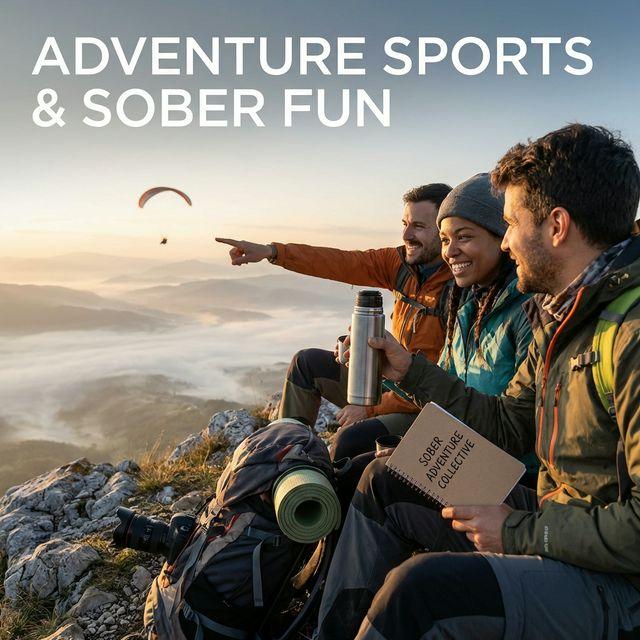
One of the most valuable aspects of adventure sports in recovery is the community that forms around shared activities. Sober surf groups, recovery climbing clubs, and clean-and-sober cycling teams provide peer connection in exciting, substance-free environments.
These communities demonstrate that sobriety is not a life of deprivation but a life of genuine engagement and adventure. New members often express surprise at how much fun sober people have and how welcoming the adventure recovery community is.
Orange County and the greater Southern California region are home to numerous sober adventure organizations. From beach bonfires after group surf sessions to post-climb meals at local restaurants, these communities create the kind of joyful, connected social experiences that make sobriety deeply satisfying.
Safety Considerations for Adventure Sports in Recovery
While adventure sports offer tremendous recovery benefits, safety must be a priority. People in early recovery may be physically deconditioned, managing medication effects, or dealing with injuries from their period of active use. Proper medical clearance, quality instruction, and gradual progression are essential.
There is also a psychological consideration. Sensation seeking, when unchecked, can lead to reckless behavior that substitutes one form of self-destruction for another. The goal is calculated adventure, not reckless thrill-seeking. Working with experienced instructors and progressing at a reasonable pace ensures that adventure activities remain a recovery asset.
If you are interested in incorporating adventure activities into your recovery plan, discuss your fitness level and health status with your treatment team. Trust SoCal can help you identify appropriate activities and connect with reputable instructors and sober adventure groups in Orange County. Call (949) 280-8360 to learn more.
Always get medical clearance before starting any new physical activity in recovery. Some adventure sports carry inherent risk, and certain medications, health conditions, or stages of recovery may require modifications or precautions.

Kristin Stevens, LCSW
Licensed Clinical Social Worker