Key Takeaways
- Daily gratitude practice increases dopamine and serotonin production, naturally countering the neurochemical deficits caused by addiction.
- People who practice gratitude regularly report 25 percent fewer stress-related health complaints and significantly better sleep quality.
- Gratitude shifts cognitive focus from scarcity and craving to abundance and contentment, reducing relapse risk.
- Writing three specific things you are grateful for each day rewires the brain's reticular activating system to notice positives over negatives.
- Expressing gratitude to others strengthens recovery relationships and builds accountability networks.
Why Gratitude Matters in Addiction Recovery
Addiction thrives in a mindset of scarcity, dissatisfaction, and negative self-focus. The addicted brain constantly seeks more, convinced that the next drink, hit, or pill will finally provide the satisfaction that remains perpetually out of reach. Gratitude directly challenges this scarcity mindset by redirecting attention toward what is already present and valuable.
This is not about toxic positivity or pretending that recovery is easy. Gratitude practice acknowledges difficulty while simultaneously recognizing the good that exists alongside the struggle. It is the ability to hold both realities at once, a capacity that builds emotional complexity and resilience.
At Trust SoCal in Fountain Valley, gratitude exercises are woven into daily programming because the research is unambiguous. Studies from leading institutions including UC Davis, Indiana University, and the Greater Good Science Center consistently demonstrate that gratitude practice improves mental health, strengthens relationships, and enhances overall well-being.
Research from the University of California, Davis found that people who kept weekly gratitude journals exercised 33 percent more, reported fewer physical symptoms, and felt 25 percent more optimistic about the future compared to those who recorded neutral or negative events.
How Gratitude Rewires the Recovering Brain
The brain has a negativity bias, an evolutionary adaptation that prioritizes threats over rewards. In early recovery, this bias is amplified by neurochemical deficits and emotional volatility. The brain defaults to noticing what is wrong, what is missing, and what could go wrong.
Gratitude practice systematically counteracts this bias through neuroplasticity. Each time you consciously identify something positive, you strengthen neural pathways associated with positive emotion and weaken those associated with negative rumination. Over weeks and months of practice, the brain's default orientation shifts.
Functional MRI studies show that gratitude practice increases activity in the medial prefrontal cortex, the region associated with learning, decision-making, and reward processing. This is the same region that is compromised by addiction and targeted in evidence-based treatment. Gratitude, in essence, exercises the very brain circuits that addiction damages.
Practical Gratitude Exercises for Every Stage of Recovery
Effective gratitude practice does not require elaborate rituals or significant time investment. The key is consistency and specificity. Vague gratitude like I am grateful for my family is less impactful than specific gratitude like I am grateful that my sister called to check on me this morning because it reminded me that she has not given up on me.
The following exercises can be adapted to any recovery stage and integrated into existing daily routines.
The Three Good Things Exercise
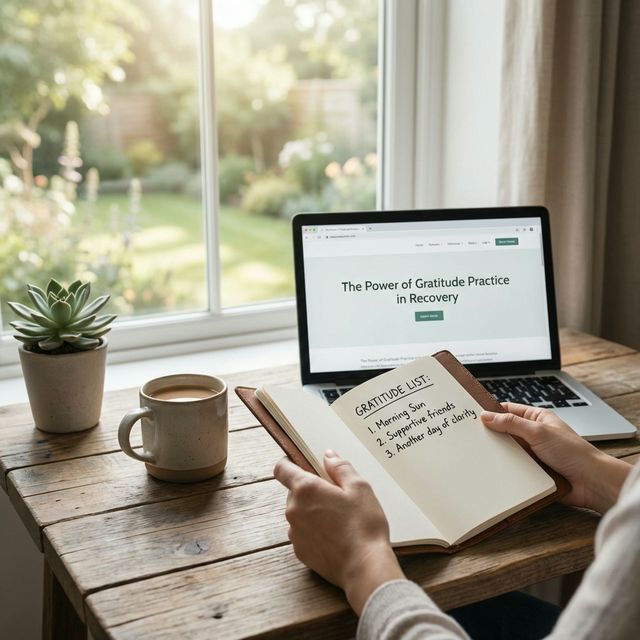
Each evening, write down three specific good things that happened during the day and your role in making them happen. This exercise, developed by positive psychologist Martin Seligman, has been shown to reduce depression symptoms for up to six months even when practiced for just one week.
In a recovery context, this exercise is particularly powerful because it builds a written record of positive experiences in sobriety. On difficult days, reviewing past entries provides concrete evidence that good things happen in recovery, countering the distorted belief that life without substances is joyless.
Gratitude Letters
Writing a detailed letter of gratitude to someone who has positively impacted your recovery, and then reading it aloud to them, is one of the most emotionally powerful gratitude exercises available. Research shows that gratitude letter writers experience significant increases in happiness scores that persist for months.
This practice also strengthens recovery relationships. Sponsors, therapists, family members, and sober friends who receive genuine expressions of appreciation are more likely to remain engaged and supportive. Gratitude creates a positive feedback loop that benefits both the giver and the receiver.
Gratitude as a Craving Management Tool
When a craving strikes, the mind narrows to a single focus: obtaining the substance. This tunnel vision excludes all other information, including the consequences of use and the benefits of sobriety. Gratitude practice can interrupt this cognitive narrowing by forcibly expanding awareness.
A practical technique is to pause during a craving and list five things you are grateful for in your current recovery. This might include your health, a relationship that has improved, a job you would not have if you were still using, a clear morning without a hangover, or simply the freedom to choose how you spend your time.
This exercise does not eliminate the craving, but it provides context. It reminds you of what you stand to lose if you act on the impulse and what you have already gained by choosing sobriety. Over time, this contextual awareness becomes automatic, a cognitive reflex that buffers against impulsive decisions.
Keep a gratitude list on your phone that you update daily. When a craving hits, open the list and read it slowly. The act of reading through accumulated positive experiences can shift your mental state within minutes.
Overcoming Resistance to Gratitude Practice
Some people resist gratitude practice because it feels forced, corny, or dismissive of real pain. These objections are valid and worth addressing. Gratitude practice is not about suppressing negative emotions or pretending that everything is fine when it is not.
Authentic gratitude coexists with difficulty. You can be grateful for your sobriety and simultaneously frustrated by the consequences of your past use. You can appreciate your support system while grieving relationships that did not survive your addiction. Holding both realities is not contradictory; it is mature and honest.
If structured gratitude exercises feel uncomfortable, start small. Notice one genuinely good thing each day, even if it is as simple as a warm cup of coffee or a few minutes of sunshine. Allow yourself to feel the pleasure of that moment without analysis or judgment. This micro-practice builds the gratitude muscle gradually and authentically.

Courtney Rolle, CMHC
Clinical Mental Health Counselor