
Key Takeaways
- Local island treatment keeps individuals connected to community but faces challenges including long waits, proximity to using environments, and limited program specialization.
- Oahu-based treatment provides access to more facilities than neighbor islands but still requires inter-island travel logistics and may not offer the comprehensive programming available on the mainland.
- Mainland treatment offers immediate or near-immediate admission, access to specialized programs, geographic separation from using environments, and professional management of distance challenges.
- Insurance coverage varies by plan and requires verification before committing to mainland treatment; many Hawaii plans provide out-of-network coverage applicable to California treatment.
- The true financial cost of treatment should account for both direct costs and indirect costs of untreated addiction or inadequate treatment leading to relapse.
- Decision-making should reflect honest assessment of addiction severity, family support systems, home environment, employment situation, and specific treatment needs rather than choosing based on convenience or apparent cost savings.
The Three Treatment Pathways for Hawaii Residents
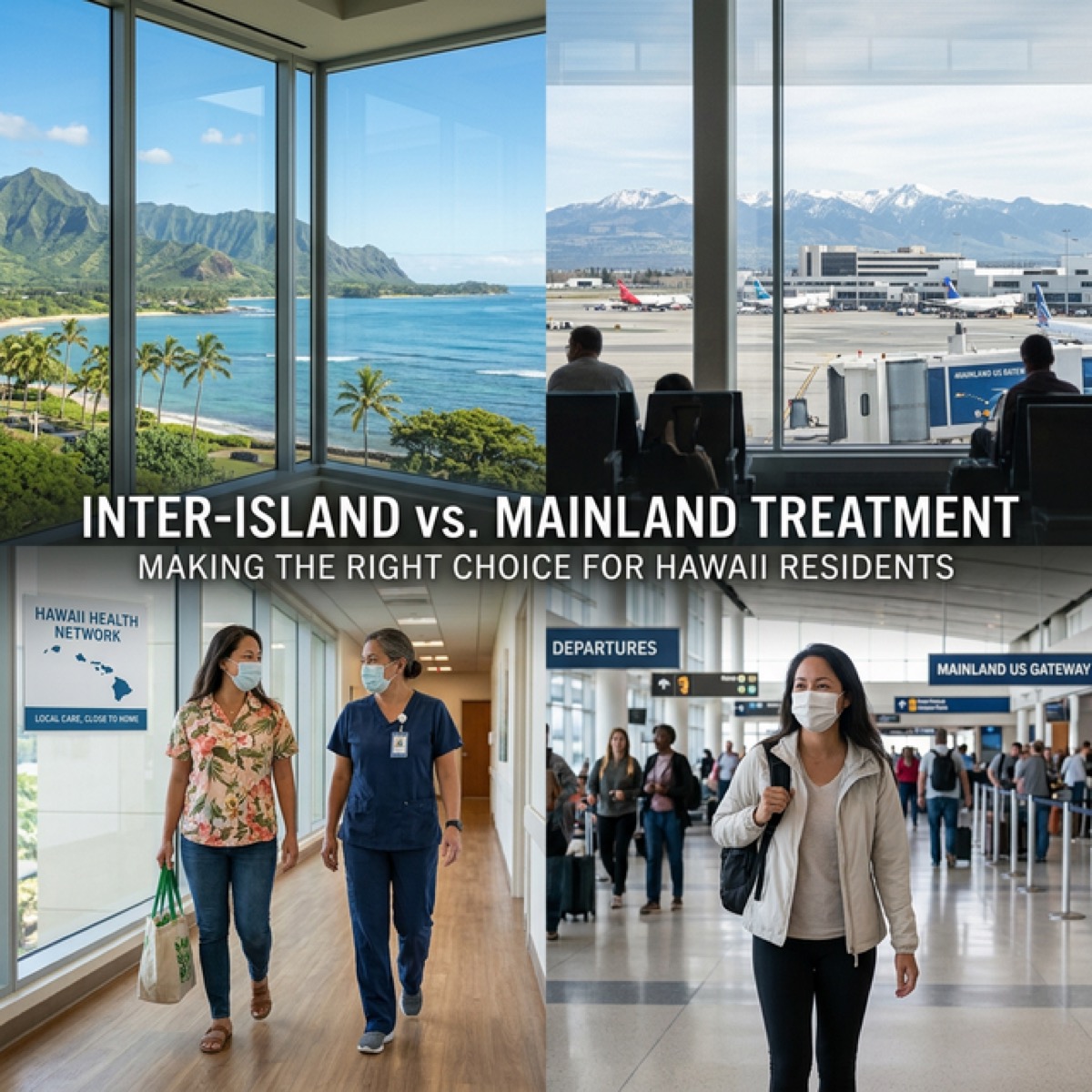
Hawaii residents struggling with addiction have three primary treatment pathways: pursuing treatment locally on their home island, traveling to Oahu to access the state's largest concentration of treatment facilities, or traveling to the mainland (typically California) for out-of-state residential programming. Each pathway has distinct advantages and limitations, and the "best" choice depends on individual circumstances including the severity of addiction, insurance coverage, family support availability, employment status, and personal preferences regarding treatment philosophy and location. Making an informed decision requires understanding what each pathway offers, what barriers and challenges each presents, and how to navigate the practical and clinical logistics involved.
Local Island-Based Treatment
Choosing local island treatment keeps the individual connected to family, community, and employment, and leverages the support systems already in place. For individuals with strong family support, stable housing, and access to a quality local program without excessive wait times, local treatment can be an excellent option that maintains community connections throughout recovery. The individual avoids the emotional challenges of being away from home, the disruption of leaving employment, and the complications of managing distance from family support systems. Recovery occurs within the context of the community where daily life unfolds, building resilience and recovery skills in the actual environment where the individual will live long-term.
However, local island treatment has significant limitations. The geographic concentration of treatment facilities creates long wait times, particularly for publicly funded programs. The small-island social dynamics mean that former drug connections, enabling relationships, and using environments remain physically proximate—often just a short drive away. The fishbowl effect of small communities means that entering treatment becomes widely known, potentially creating community stigma or complicated social dynamics upon return. For individuals with severe addictions, those in environments where active substance use by others is ongoing, or those without strong family support, local treatment may be insufficient despite its advantages of proximity.
The decision to pursue local treatment should include honest assessment of whether waiting weeks or months for a bed serves your clinical interests—extended waiting periods while motivation wanes and addiction progresses are dangerous. It should also include assessment of whether your home environment supports recovery: if household members actively use substances, if your neighborhood has active drug markets, or if former associations readily reconnect you with people involved in your using, local treatment faces significant headwinds. For some, local treatment works beautifully. For others, the local environment undermines recovery despite intensive therapeutic work.
If considering local island treatment, ask directly about wait times for your preferred program and funding source. If the wait is longer than two weeks and your motivation for treatment is high, consider whether interim outpatient services or evaluation of alternative treatment locations might better serve your immediate needs.
Travel to Oahu for Treatment
Many neighbor island residents choose to travel to Oahu to access the state's largest concentration of treatment facilities, viewing this as a middle ground between local island treatment and mainland options. The inter-island flight is relatively short—approximately one hour from Maui, 40 to 50 minutes from Big Island—and flights are frequent and relatively affordable with advance planning. Oahu treatment offers access to more facilities than neighbor islands, potentially shorter waits than local programs, and the advantage of geographic separation from home environments while maintaining somewhat closer proximity to family and home than mainland treatment would require.
However, Oahu-based treatment has its own limitations. Oahu's treatment system, while larger than neighbor island systems, still experiences capacity constraints and waiting lists. Traveling to Oahu removes the individual from their home community and support systems, creating the distance challenges of mainland treatment while not offering the fuller range of specialized programs available on the mainland. The logistics of managing inter-island travel—arranging transportation to the airport, managing luggage and personal items, coordinating family visits—creates friction compared to both local treatment and mainland treatment where dedicated admissions staff typically handle logistics. For many neighbor island residents, the choice comes down to: accept long waits for local treatment, incur the logistics and cost of inter-island travel to Oahu, or invest in mainland travel for access to superior options and immediate admission.
Mainland Treatment: Benefits and Considerations
Mainland treatment—particularly in Southern California where Trust SoCal is located—offers significant clinical and practical advantages for Hawaii residents willing to invest in travel and distance from home. The Southern California treatment market is one of the largest and most specialized in the nation, with thousands of residential beds and programs addressing every type of addiction, specialized population, and treatment philosophy. Immediate or near-immediate admission is typically possible without the multi-week waits that characterize Hawaii's treatment system. The geographic distance from home environments provides powerful therapeutic separation that supports early recovery, eliminating daily proximity to former drug connections, using environments, and triggering relationships.
Trust SoCal and other Southern California programs have extensive experience working with Hawaii residents and understand the unique logistics of coordinating care across state lines, including insurance verification with Hawaii providers, travel arrangements, and family involvement despite geographic distance. The five-hour flight from Hawaii to Southern California takes only slightly longer than driving across the Big Island and ferrying to Oahu, making the distance manageable. The diversity of the Southern California population means that Hawaiian and Pacific Islander clients find cultural familiarity and diverse communities that understand island cultures and values.
The investment in mainland treatment is substantial—flights, temporary relocation from home, separation from family—but for many Hawaii residents, the clinical benefits outweigh the costs. The combination of immediate admission, specialized programming, geographic separation from using environments, and professional support for managing the distance makes mainland treatment a powerful option. Call Trust SoCal at (949) 280-8360 to discuss whether this pathway might serve your recovery needs and to understand what insurance coverage might apply to mainland treatment for Hawaii residents.
Financial Considerations and Insurance
Insurance coverage is a critical factor in treatment pathway decisions. Most Hawaii health insurance plans—including plans sold by HMSA, Kaiser Permanente, and UHA—provide some out-of-network coverage that can be applied to mainland treatment. The extent of out-of-network benefits varies by plan, requiring verification of specific coverage details before committing to mainland treatment. QUEST Integration (Hawaii Medicaid) coverage varies by managed care plan and by treatment facility location, with some flexibility for out-of-state treatment in certain circumstances. Self-pay and financing options are available for individuals without insurance or with limited coverage.
The true financial cost of mainland treatment must account for both direct treatment costs and ancillary expenses including flights, accommodations, meals, and transportation. However, these costs must be weighed against the financial costs of waiting weeks for local treatment—costs including lost income, continuation of addiction-related expenses, legal fees, medical complications, and other expenses that accumulate during periods of untreated addiction. From a purely financial perspective, comprehensive treatment investment today typically saves money compared to the economic costs of untreated addiction or inadequate treatment leading to relapse and re-entry into the treatment cycle.
Decision Framework: Which Pathway is Right for You?
Deciding on the right treatment pathway requires honest assessment across multiple dimensions. Consider the severity of your addiction: individuals with severe or long-standing addictions typically benefit from the more intensive structure and resources of mainland treatment or larger Oahu programs rather than smaller local programs. Consider your family support: if strong family support is available and able to visit regularly, local treatment or nearby Oahu treatment might work. If your family is supportive but geographically distant anyway, the additional distance of mainland treatment may not add significant burden.
Assess your home environment: if household members use substances, if your neighborhood has active drug markets, or if your street connections are deep and readily reactivated, geographic separation through mainland treatment becomes clinically more valuable. Consider employment and life logistics: if you have employment that cannot be suspended, you may need to choose between local outpatient treatment or residential treatment elsewhere. If you are in crisis and motivation is high, waiting weeks for a local bed may undermine recovery more than investing in immediate mainland admission.
Consider your insurance coverage: verify coverage for each option and understand what costs you would incur. Consider specialization: if you need particular types of programming—treatment for a specific substance, co-occurring mental health conditions, cultural specificity for your background—verify what specialization is available locally, on Oahu, and on the mainland. Make your decision based on what will best support your recovery, not based on what feels easiest in the moment or what seems cheapest upfront. Trust SoCal at (949) 280-8360 can help you understand how mainland treatment might fit your specific situation and can coordinate insurance verification, clinical assessment, and admission logistics.

Kristin Stevens, LCSW
Licensed Clinical Social Worker

